BILL and the Vatican Monday November 19, 2007
Sending this from Bill--so appropos right now with the Global work against the Death Penalty and at least one of us-- if not several of our Journey of Hope (JOH) folk-abolition-moratorium folk-- in Italy right now! Hope we all hear more on that trip soon. Soon we should have some old and new photos to post related to the Vatican and also plenty more from Texas "Journey" 2007... Please send me your items, photos, etc.
Edward - Mgagi- Edmary of Uganda will have more to say about these events/issues as well whether or not he was able to make these events in Italy.
Connie L. Nash
~~~~~~
Bill Pelke
One cold December day in 1998 I received a call from Sergio D’Elia. Sergio was the director of Hands off Cain in Italy, an organization working for worldwide abolition of the death penalty. He had been on the Texas Journey a few months earlier when we marched to the State Capital in Austin behind our 24-foot Journey of Hope banner.
Sergio wanted some members of the Journey of Hope to come to Italy with our banner and lead a march to the Vatican on Christmas morning when the Pope would deliver his annual worldwide address. The purpose of the march was to ask the Pope to make a statement about the death penalty.
Kathy Harris and I flew to Rome with the Journey banner about a week before Christmas. Kathy and I did numerous interviews encouraging people to join the march. The Paula Cooper case was still very familiar on the minds of many Italians.
It was quite impressive to walk down the streets of Rome and see posters all over advertising the march to the Vatican.
Christmas day was quite an affair, beginning early in the morning as thousands gathered at a square called DA Campo Dei Fiori a San Pietro. Gordano Bruno, a philosopher, was burned at the stake in 1600 as a heretic at this square.
Several people spoke and a quartet of women sang. Kathy and Barbara Bacci, one of the organizers read the names of the one hundred and fifty men on the Texas death row who had written the Pope, asking to be remembered in prayers. I spoke about the death penalty and the importance of the international community in helping to bring about the worldwide abolition of it. Sam Reese Sheppard and Rev. Melodee Smith were to arrive before the march, but a flight delay made them miss the rally and march.
As the march toward Vatican began, the twenty-four-foot Journey of Hope…from Violence to Healing banner led the march. Behind us were people carrying the flags of over one hundred cities. The mayor of Rome marched with us. According to the evening news there were as many as seven thousand people on our march to the Vatican.
When we arrived at the Vatican, there were already about thirty thousand gathered to hear the Pope’s annual Christmas address. We joined in with the crowd. Thousands more arrived before Pope John Paul II began to read his prepared speech. He suddenly stopped his reading and made mention of those who had marched to the Vatican protesting the death penalty. He thanked the organizers of the march and those who participated in it.
The purpose of the march was to ask the Pope to make a statement about the death penalty and John Paul II did just that. For the first time publicly, he called for worldwide abolition of the death penalty. He said that is was cruel and unnecessary. The crowd applauded his words.
~~~~~~
PS Bill and others (Sister Helen too!)have some more old and newer notes on this experience and on the phrase that the death penalty "is/was cruel and unnecessary" which we hope to get to this blog soon.
~~~~~~
For any who may not have seen mine, David's or others on the Global Moratorium, here's some great news & a wise comment:
And the sky did not fall November 15, 2007
This just popped up in my email box from Renny Cushing, executive director of Murder Victims' Families for Human Rights.
The United Nations General Assembly just passed a resolution calling for a worldwide moratorium on executions! The vote was 99 in Favor, 52 Against and 33 Abstentions. Another step toward a world without the death penalty!
Of course, we shouldn't abolish the death penalty because the U.N. says we should or France or Germany or Canada say we should. We should abolish it because it is flawed public policy.
(Posted by David Elliot on NCADP Blog...well worth reading often!
Coming--more items from or related to issues, people active in the Journey of Hope and their exeriences.
Thanks for tuning in--tell others about this blog, will you? Send them the url.
Connie
newlease7@yahoo.com
Monday, November 19, 2007
Tuesday, November 13, 2007
This 'n that after the Journey
.jpg)
Hello, glad you tuned in. Here is the first blog we're submitting since the Journey of Hope, Texas, 2007, ended recently. David's name may come up each time for awhile because of the technical set-up. Please bear with me as I get used to doing these blogs. The first may be a bit rough. Also, I'm not yet adept at how to do some of the photos, attachments. Connie L. Nash
First, here's a wonderful collection of photos with an article. All who were with us will love this reminder & for others, it's quite a bird's eye view into this recent Journey:
http://houston.indymedia.org/news/2007/10/61754.php
Here's a brief note from Jim (of Carter and Jim--steadfast friends who were with us on the Journey).
Carter and Lilly Flores have a son, Charles, on death row in Texas. Charles under the Law of Parties, a Texas law. An elder at the Edgefield Iglesia de Cristo Church in Dallas. Carter is active with the Texas Coalition to Abolish the Death Penalty and the Dallas Chapter of Amnesty International USA. See the indymedia url above for a photo of Carter.
Jim and his wife Susan--the Ulrichs--have been long-time friends of several death row inmates and close friends of the Flores. Jim helped the Flores son, Charles, in the writing of his book -Warrior Within- a personal account of his story and of life on Texas death row.
This short piece is from Jim:
I attached a picture of a headstone I found on our visit to Huntsville.
Carter was with me. I knew the man through my wife who was his penpal. I read his letters and have his artwork. He didn't have an execution date when Sue went down to visit charlie and calvin. when she got there she was told calvin wasn't in the unit. come to find out he'd died of an anurism the week before. Sue contacted his sister, who was also in prison, and went to visit her. Within a year, his sister died of the same thing! Calvin was in the midst of making the illustrations for a children's story book.
Carter noticed I was reflecting on Calvin's grave, so I joined with him in prayer for calvin. He held my hand. It had to be difficult for Carter to console me in my grief for Calvin and for Sue in the very place where he wants least to be reminded of what is likely to happen to his own son. But he thanked me for telling the story of Calvin. Through my friendship with Carter and the family I've gotten just a little bit of the experience of the victims in the circle of the condemned. Pray that I don't get a lot more of that experience.
shalom
jim ulrich
See Jim's attached photo
Note:
There is more on Carter & his son's case below:
http://www.journeyofhope.org/pages/carter_lily_flores.htm
More on Charles Flores book (written with Jim):
http://media.houston.indymedia.org/uploads/2007/10/journeybook.jpg
Great news on Edward--who's full name is Mpagi Edward Edmary. Edward's now finally in full health--having suffered an unexpected and quite serious ailment as soon as arriving with us at the JOH in Texas. This continued to be problematic for him throughout the Journey. Right after the Journey ended, he had outpatient surgery and then shortly afterwards another hospital procedure. He's also now happily back home in Uganda where he works with inmates, their families and their children--especially in the areas of education and forgiveness.
For any who don't know about Edward, he spent 18 years on Uganda's death row although the man he allegedly murdered showed up alive three years before he was finally released. More on Edward and the Global Moratorium Campaign soon. Or if you are interested, email me for more information.
Look for a Bill Pelke's piece next. Bill is our founder-visionary, director and ongoing inspiration. He's not bad at stories either.
Send your items, comments or questions to Connie Nash
newlease7@yahoo.com
Friday, October 26, 2007
Another update from The Journey
From the ground in Texas:
Abolitionists/Moratorium folk--people of faith and those seeking human rights for all: we want you to help spread the word that we are in Texas representing you. We need all your support: letters to the editor, legislative, funding, prayers, etc. Let folk know we are here! So far,we have had warm reception and some changed hearts and mind.
We have quite a few venues left including in Waco, interviews with The Dallas Morning News, an SMU event and a big March/Rally in Houston. Come if you are able and get the word out. We are worth your time and dollars!
journeyofhope.org/pages/foundersschedule.htm
Look at our remaining schedule -- join the dialogue
Thanks for all you do and are for "love and compassion for ALL humanity" as Bill Pelke says often.
Our warmest greetings,
The Journey of Hope Folk in Austin
Abolitionists/Moratorium folk--people of faith and those seeking human rights for all: we want you to help spread the word that we are in Texas representing you. We need all your support: letters to the editor, legislative, funding, prayers, etc. Let folk know we are here! So far,we have had warm reception and some changed hearts and mind.
We have quite a few venues left including in Waco, interviews with The Dallas Morning News, an SMU event and a big March/Rally in Houston. Come if you are able and get the word out. We are worth your time and dollars!
journeyofhope.org/pages/foundersschedule.htm
Look at our remaining schedule -- join the dialogue
Thanks for all you do and are for "love and compassion for ALL humanity" as Bill Pelke says often.
Our warmest greetings,
The Journey of Hope Folk in Austin
Tuesday, October 23, 2007
Update from the Texas Journey
This good article appeared today in The Lariat, which is the student newspaper at Baylor University. Nice work, Journey folk!
Group hopes to raise death penalty awareness
The death penalty is reserved for criminals who have committed cruel,
inhumane crimes- acts that give their victims and their victims' loved
ones little room for compassion. But the members of Journey of Hope find
room.
"No other group has power and authority to speak about forgiveness than
(the members of Journey of Hope). They have no reason to forgive, but they
do," Fernando Arroyo, chair of Waco Amnesty International, said.
Baylor National Association of Social Workers and Baylor Students for
Social Justice in association with Waco Amnesty International will join
Journey of Hope to speak about death penalty alternatives on campus
Thursday morning in Kayser Auditorium.
Step by Step, a documentary about Journey of Hope members will be shown
from 8:30 to 10 a.m., and Journey of Hope members will speak from 10:30
a.m. to noon. Each session will be followed by a question-and-answer
session.
Family members of murder victims and the executed and exonerated lead
Journey of Hope. They conduct public education speaking tours to address
alternatives to the death penalty.
Amnesty International, an organization supporting different human rights
issues, is the umbrella organization for Journey of Hope. Their main
action for human rights is letter writing, but having an event on campus
is something Arroyo, said he has always wanted.
Arroyo said Amnesty International has received a lot of help from Baylor
students, especially in helping to promote 2 main campaigns - Journey of
Hope and genocide in Darfur and Sudan.
Last semester Amnesty International held 6 film sessions in Waco that many
Baylor students were involved in. This year, they hope more students will
be able to take something away from Journey of Hope since they will be
speaking on campus.
"We have the privilege of having the founders come," Arroyo said.
Executive Director Bill Pelke will speak to students and answer questions
on behalf of Journey of Hope.
"It's a platform for family members of victims to share their story, and,
in some cases, prove death row inmates' innocence," Arroyo said. "It puts
a human face on the death penalty."
Journey of Hope is not a Christian organization because it's mission is to
gather people of all belief systems who share in its mission.
"It's their faith that's helped them overcome hatred and revenge and it's
what has helped them overcome the bitterness creeping into their heart,"
Arroyo said. "They find healing and the miracle of forgiveness in their
hearts and want to pass is around in the lives of victims and their
perpetrators."
McGregor senior Flor Avellanedo, president of Baylor's social work
association helped to organize the event. "It's a miraculous thing -- that
God gives people the power to forgive and speak on behalf of them," she
said.
Members of Journey of Hope said they believe there's only an allusion of
closure when a murderer is executed.
Arroyo said family members end up destroying true reconciliation that
could take place after the murder of a family member.
"It's so sad to think how many innocent people we've sent to death row,"
he said "Even if it's one, it's too many."
Acknowledging that the death penalty is a controversial issue, Avellanedo
said, "We all have our opposing views of the death penalty, but it's
always good to be aware of other views so we can reflect and think twice
about what we think."
Andrea Brashier, Carrolton senior and association member, said she will
attend the event because she wants to support awareness of the justice
system.
"I think we have a lot of room to grow in that area so I think this
program will open our eyes to thinking about other options, especially as
students of a Christian school," she said.
Arroyo hopes the event will start more dialogue about the issue and prompt
action.
Group hopes to raise death penalty awareness
The death penalty is reserved for criminals who have committed cruel,
inhumane crimes- acts that give their victims and their victims' loved
ones little room for compassion. But the members of Journey of Hope find
room.
"No other group has power and authority to speak about forgiveness than
(the members of Journey of Hope). They have no reason to forgive, but they
do," Fernando Arroyo, chair of Waco Amnesty International, said.
Baylor National Association of Social Workers and Baylor Students for
Social Justice in association with Waco Amnesty International will join
Journey of Hope to speak about death penalty alternatives on campus
Thursday morning in Kayser Auditorium.
Step by Step, a documentary about Journey of Hope members will be shown
from 8:30 to 10 a.m., and Journey of Hope members will speak from 10:30
a.m. to noon. Each session will be followed by a question-and-answer
session.
Family members of murder victims and the executed and exonerated lead
Journey of Hope. They conduct public education speaking tours to address
alternatives to the death penalty.
Amnesty International, an organization supporting different human rights
issues, is the umbrella organization for Journey of Hope. Their main
action for human rights is letter writing, but having an event on campus
is something Arroyo, said he has always wanted.
Arroyo said Amnesty International has received a lot of help from Baylor
students, especially in helping to promote 2 main campaigns - Journey of
Hope and genocide in Darfur and Sudan.
Last semester Amnesty International held 6 film sessions in Waco that many
Baylor students were involved in. This year, they hope more students will
be able to take something away from Journey of Hope since they will be
speaking on campus.
"We have the privilege of having the founders come," Arroyo said.
Executive Director Bill Pelke will speak to students and answer questions
on behalf of Journey of Hope.
"It's a platform for family members of victims to share their story, and,
in some cases, prove death row inmates' innocence," Arroyo said. "It puts
a human face on the death penalty."
Journey of Hope is not a Christian organization because it's mission is to
gather people of all belief systems who share in its mission.
"It's their faith that's helped them overcome hatred and revenge and it's
what has helped them overcome the bitterness creeping into their heart,"
Arroyo said. "They find healing and the miracle of forgiveness in their
hearts and want to pass is around in the lives of victims and their
perpetrators."
McGregor senior Flor Avellanedo, president of Baylor's social work
association helped to organize the event. "It's a miraculous thing -- that
God gives people the power to forgive and speak on behalf of them," she
said.
Members of Journey of Hope said they believe there's only an allusion of
closure when a murderer is executed.
Arroyo said family members end up destroying true reconciliation that
could take place after the murder of a family member.
"It's so sad to think how many innocent people we've sent to death row,"
he said "Even if it's one, it's too many."
Acknowledging that the death penalty is a controversial issue, Avellanedo
said, "We all have our opposing views of the death penalty, but it's
always good to be aware of other views so we can reflect and think twice
about what we think."
Andrea Brashier, Carrolton senior and association member, said she will
attend the event because she wants to support awareness of the justice
system.
"I think we have a lot of room to grow in that area so I think this
program will open our eyes to thinking about other options, especially as
students of a Christian school," she said.
Arroyo hopes the event will start more dialogue about the issue and prompt
action.
Friday, October 19, 2007
Where are we on lethal injection executions?
Rather than comment myself, I thought I would post this informative article from Stateline.org:
What was scheduled to be a busy week in the nations death chambers instead
has offered growing evidence that a moratorium on lethal injection is
materializing across the country even as a U.S. Supreme Court justice
suggested that some executions should go on.
Virginia last night (Oct. 17) became the 16th state where executions by
lethal injection effectively are on hold. The U.S. Supreme Court, without
giving a reason, granted a stay to convicted murderer Christopher Scott
Emmett 4 hours before he was scheduled to die at the Greensville
Correctional Center in Jarratt, Va.
It was the second time this week that a court delayed a lethal injection
with little time to spare. On Monday (Oct. 15), the Nevada Supreme Court
granted a stay to killer William Castillo 90 minutes before he was set to
die, even though Castillo himself did not appeal the punishment and later
expressed disappointment that he was not put to death. The American Civil
Liberties Union of Nevada brought the case.
Arkansas, Ohio and Georgia also were scheduled to execute prisoners using
lethal injection this week, but only the execution in Georgia set for 7
p.m. Friday (Oct. 19) remains a possibility, as earlier court decisions
delayed the other executions. (Blogger's update: the Georgia Supreme Court on Wednesday stayed Friday's scheduled execution, citing the U.S. Supreme Court's acceptance of cert in the Kentucky case.)
The flurry of activity follows the U.S. Supreme Court's decision on Sept.
25 to hear Baze v. Rees, a case brought by 2 Kentucky prisoners who argue
that lethal injection as it is carried out by 36 states amounts to cruel
and unusual punishment in violation of the Eighth Amendment. (See related
story: Lethal injection goes on trial, but goes on)
The high courts decision last month to enter the debate over lethal
injection has had an immediate chilling effect across the country, as
lawyers for death-row prisoners have argued that states should not carry
out death sentences using a method that may be ruled unconstitutional.
Executions in Alabama, Arizona, Arkansas and Texas were suspended after
the Supreme Court took up the Kentucky prisoners challenge, and Nevada and
Virginia joined those states this week.
Speaking directly to the possibility of a nationwide moratorium on lethal
injection, Supreme Court Justice Antonin Scalia on Tuesday (Oct. 16)
cautioned that stopping all executions by that method wasn't the high
court's intention when it agreed to hear Baze v. Rees. Just because the
justices agreed to take on the case, Scalia said, doesn't necessarily mean
that a moratorium should ensue.
Overall, 16 states now have governor-imposed or court-ordered holds on
lethal injection: Alabama, Arizona, Arkansas, California, Delaware,
Florida, Kentucky, Maryland, Missouri, Nevada, New Jersey, North Carolina,
Ohio, Tennessee, Texas and Virginia, according to the Death Penalty
Information Center, which opposes capital punishment.
Lethal injection was placed on hold in 10 of those states before the
Supreme Court agreed to hear Baze v. Rees, underscoring the legal
uncertainty that has surrounded the procedure for much of the past 2
years.
Meanwhile, only 2 states where lethal injections are not on hold Georgia
and Mississippi have set execution dates for prisoners before next
spring, when the Supreme Court is expected to rule in Baze v. Rees,
according to the Death Penalty Information Center, which maintains an
updated list of upcoming executions. (Blogger's update: slight error here. Alabama and Florida still have executions pending. We hope these will be stayed. But as of right now, they remain pending and should be considered serious dates.)
After Georgia's scheduled execution on Friday and another in that state
set for Oct. 23 Mississippi is scheduled to execute Earl Wesley Berry on
Oct. 30.
On Tuesday, Scalia disagreed with the 8th U.S. Circuit Court of Appeal's
decision to stay the execution of Arkansas death-row inmate Jack Harold
Jones Jr., who was scheduled to die that day.
Scalia, dissenting from the Supreme Court majority, wrote that the circuit
court's opinion was "based on the mistaken premise that our grant of
certiorari in Baze v. Rees calls for the stay of every execution in which
an individual raises an Eighth Amendment challenge to the lethal injection
protocol."
Granting certiorari means the Supreme Court has agreed to hear a case.
"The grant of certiorari in a single case does not alter the application
of normal rules of procedure," Scalia wrote.
Legal experts said Scalias statement gave a good indication of his
personal views, but did not necessarily signal that a national moratorium
would be averted.
"The fact that it's a dissent says more than anything. It suggests that a
majority of the court disagrees with that perspective," said Bryan
Stevenson, a law professor at New York University and executive director
of the Equal Justice Initiative, a nonprofit legal clinic.
In the meantime, lower courts already have begun to issue stays of
execution on their own, Stevenson said, pointing to the Nevada Supreme
Courts decision this week, as well as a decision by the Texas Court of
Criminal Appeals earlier this month.
Attention now remains focused on Georgia, where state officials have vowed
to move ahead with the execution Friday of killer Jack Alderman, as well
as the scheduled execution by lethal injection on Oct. 23 of Curtis
Osborne.
The Georgia Supreme Court this week rejected Alderman's request for a
stay, arguing as Scalia did that the U.S. Supreme Court "has not yet
indicated that, in cases in this posture, all executions by lethal
injection should be stayed," according to the Georgia courts opinion.
But Michael Siem, one of the lawyers working on a stay for Alderman, told
Stateline.org that the precedent already has been set at least for now.
"Our position is this: Every state but Virginia and Georgia has stayed
executions [scheduled since the court agreed to hear Baze v. Rees]," Siem
said before last night's stay in Virginia. "If that isn't a direct
indication to the states what they should be doing, I don't know what is."
What was scheduled to be a busy week in the nations death chambers instead
has offered growing evidence that a moratorium on lethal injection is
materializing across the country even as a U.S. Supreme Court justice
suggested that some executions should go on.
Virginia last night (Oct. 17) became the 16th state where executions by
lethal injection effectively are on hold. The U.S. Supreme Court, without
giving a reason, granted a stay to convicted murderer Christopher Scott
Emmett 4 hours before he was scheduled to die at the Greensville
Correctional Center in Jarratt, Va.
It was the second time this week that a court delayed a lethal injection
with little time to spare. On Monday (Oct. 15), the Nevada Supreme Court
granted a stay to killer William Castillo 90 minutes before he was set to
die, even though Castillo himself did not appeal the punishment and later
expressed disappointment that he was not put to death. The American Civil
Liberties Union of Nevada brought the case.
Arkansas, Ohio and Georgia also were scheduled to execute prisoners using
lethal injection this week, but only the execution in Georgia set for 7
p.m. Friday (Oct. 19) remains a possibility, as earlier court decisions
delayed the other executions. (Blogger's update: the Georgia Supreme Court on Wednesday stayed Friday's scheduled execution, citing the U.S. Supreme Court's acceptance of cert in the Kentucky case.)
The flurry of activity follows the U.S. Supreme Court's decision on Sept.
25 to hear Baze v. Rees, a case brought by 2 Kentucky prisoners who argue
that lethal injection as it is carried out by 36 states amounts to cruel
and unusual punishment in violation of the Eighth Amendment. (See related
story: Lethal injection goes on trial, but goes on)
The high courts decision last month to enter the debate over lethal
injection has had an immediate chilling effect across the country, as
lawyers for death-row prisoners have argued that states should not carry
out death sentences using a method that may be ruled unconstitutional.
Executions in Alabama, Arizona, Arkansas and Texas were suspended after
the Supreme Court took up the Kentucky prisoners challenge, and Nevada and
Virginia joined those states this week.
Speaking directly to the possibility of a nationwide moratorium on lethal
injection, Supreme Court Justice Antonin Scalia on Tuesday (Oct. 16)
cautioned that stopping all executions by that method wasn't the high
court's intention when it agreed to hear Baze v. Rees. Just because the
justices agreed to take on the case, Scalia said, doesn't necessarily mean
that a moratorium should ensue.
Overall, 16 states now have governor-imposed or court-ordered holds on
lethal injection: Alabama, Arizona, Arkansas, California, Delaware,
Florida, Kentucky, Maryland, Missouri, Nevada, New Jersey, North Carolina,
Ohio, Tennessee, Texas and Virginia, according to the Death Penalty
Information Center, which opposes capital punishment.
Lethal injection was placed on hold in 10 of those states before the
Supreme Court agreed to hear Baze v. Rees, underscoring the legal
uncertainty that has surrounded the procedure for much of the past 2
years.
Meanwhile, only 2 states where lethal injections are not on hold Georgia
and Mississippi have set execution dates for prisoners before next
spring, when the Supreme Court is expected to rule in Baze v. Rees,
according to the Death Penalty Information Center, which maintains an
updated list of upcoming executions. (Blogger's update: slight error here. Alabama and Florida still have executions pending. We hope these will be stayed. But as of right now, they remain pending and should be considered serious dates.)
After Georgia's scheduled execution on Friday and another in that state
set for Oct. 23 Mississippi is scheduled to execute Earl Wesley Berry on
Oct. 30.
On Tuesday, Scalia disagreed with the 8th U.S. Circuit Court of Appeal's
decision to stay the execution of Arkansas death-row inmate Jack Harold
Jones Jr., who was scheduled to die that day.
Scalia, dissenting from the Supreme Court majority, wrote that the circuit
court's opinion was "based on the mistaken premise that our grant of
certiorari in Baze v. Rees calls for the stay of every execution in which
an individual raises an Eighth Amendment challenge to the lethal injection
protocol."
Granting certiorari means the Supreme Court has agreed to hear a case.
"The grant of certiorari in a single case does not alter the application
of normal rules of procedure," Scalia wrote.
Legal experts said Scalias statement gave a good indication of his
personal views, but did not necessarily signal that a national moratorium
would be averted.
"The fact that it's a dissent says more than anything. It suggests that a
majority of the court disagrees with that perspective," said Bryan
Stevenson, a law professor at New York University and executive director
of the Equal Justice Initiative, a nonprofit legal clinic.
In the meantime, lower courts already have begun to issue stays of
execution on their own, Stevenson said, pointing to the Nevada Supreme
Courts decision this week, as well as a decision by the Texas Court of
Criminal Appeals earlier this month.
Attention now remains focused on Georgia, where state officials have vowed
to move ahead with the execution Friday of killer Jack Alderman, as well
as the scheduled execution by lethal injection on Oct. 23 of Curtis
Osborne.
The Georgia Supreme Court this week rejected Alderman's request for a
stay, arguing as Scalia did that the U.S. Supreme Court "has not yet
indicated that, in cases in this posture, all executions by lethal
injection should be stayed," according to the Georgia courts opinion.
But Michael Siem, one of the lawyers working on a stay for Alderman, told
Stateline.org that the precedent already has been set at least for now.
"Our position is this: Every state but Virginia and Georgia has stayed
executions [scheduled since the court agreed to hear Baze v. Rees]," Siem
said before last night's stay in Virginia. "If that isn't a direct
indication to the states what they should be doing, I don't know what is."
Thursday, October 18, 2007
The Journey of Hope begins in Texas
This just in, from Connie Nash, who is participating in the current Journey of Hope...From Violence to Healing:
Report #1 on the Texas Journey 2007
From Houston on Thursday afternoon...
Hello, this is a quickly pulled-together report right before some of us take off for San Antonio, Dallas, etc. Not yet sure in what order. Sound familiar?(smiles)
We have had a rich & wondrous week in Houston. Of course we are all cry-babies and huggers and so there were lots of the same this morning as some of this Journey's group took off for various & sundry places.
To start more-or-less at the beginning:
Most of us stayed at the Dominican Sisters place on Almeda. Later, we want to tell you about their beautiful mission so in keeping with our own. Of course, their welcoming us with open arms wasn't hurt at all by the fact that Sister Helen was with us for several days and spoke in their chapel.
The first real gathering with all of us began with a bang! We saw together the DVD of the '98 Journey of Hope which is just now completed & in process of release to several venues. Quite a few of us were in that film. Of course watching this, we felt the presence of many other Journey folk and abolitionists as we teared up and laughed together.
Highlights:
"We plan to be on the road 'til the death penalty is abolished..."
Ron Carlson "The hardest thing I ever did was to forgive (Carla Faye Tucker)...I took the time to get to know Carla Faye. She was the firmest believer I've ever met."
"It wasn't hate that sustained me, it was love."
Ken & Louis Robinson "Texas is 50th in the nation for (not) taking care of mentally ill...cutting mental health (funding) to build more prisons."
"(Folk) don't want babies killed...(they) just want adults killed."
Execution "dehumanizes the (criminal) just as they dehumanize their victim."
George "We're not on different sides... you can't restore something that you kill."
"Hatred is simply not healthy." Sister Helen or Marietta?
From an angry bystander right after a state killing: "They should be tortured & let everyone see it."
Bill Pelke "To forgive is not condoning. Forgiving Paula (Cooper) did more for me than it did for Paula."
After the film, we got acquainted & reacquainted...
Here is just a wee bit from this sharing...
CeCe McWee "My son first asked me not to witness his execution but I refused and went. We were asked by the prison officials not to express emotions. I didn't cry but later in the shower I felt the salt more than the water. I still keep trying to ask myself 'what more could I have done for my son?'" (CeCe also lost a daughter to murder)
Dave Atwood "We are here in the Belly of the Beast--(or maybe) the Belly of the Belly of the Beast. We still have politicians to change--it's a political animal here."
A group of Koreans were with us. Father Li who ministers to death row inmates and other prisoners and certain sacred remembrances, washes the feet of these inmates. Mr. Ko lost three family members to a murder and forgives the serial killer. Much more on this group later.
Read about others here on this site and I will tell you more about each later.
Well, I'm gonna go quickly through the rest of the week because I know any moment the cars will roll out of here...
HIGHLIGHTS
Concert with Nancy G. and Charlie King. Presentations by Mr. Ko, Father Li and Sister Helen. This night was so well-received although the collection barely paid the expenses.
We gathered the next evening...
Sister Helen to Bill P. "Was it tense for you last night?"
Bill "It's been tense the last six months."
Lisa "I'm a Johnny Appleseed but I never see the apples." (Lisa does Restorative Justice work since '89. She has been a key player in the release of an
inmate.)
We all got to talk with Abe B. and Susan B. by phone and felt so connected and close to them.
Ron talked about how "People show up like tulips" one of many fresh metaphors and phrases were were to hear throughout this week.
One of the "vindicated" (new term for exoneree) thanked the activist and supporters for being with us.
Greg P. Audel, a local lawyer who was a close friend of Karla Faye and is a close friend of Sister Helen said, "We're here to lift all of society up--that's why we're here."
Well there's ever so much more about this week to tell. These are only a few of the highlights. More nd tidbits from Dallas on Houston part #2 soon. Look forward to an amazing scenario at a youth center in a challenging neighborhood--the way they connected with Terri and her deep concerns for her son who's on death row for a crime he didn't do--and their connections also with the "vindicated" guys--
Find out soon how to download or hear online a radio program with Greg and Shujaa that you won't believe, there was an incredibly polished and moving set-up on screen with many profound quotes silently presented as Sister Helen and Terri's told their stories at St.
Pius X High School. The students were the leaders and warm receivers. There was a couple in the audience who have a brother on Texas Death Row--friends of Monica (of Sweden) and Robin who've been with us on the Journey. They are all family in supporting Roger on Texas Death Row.
In closing, part #1 from Jim U who helped edit and write a book with a Texas death row inmate, Carter Flores' son.
"Taking my first Journey (not my last) has deepened and motivated me as an actrivist and a whole person.
It was a privelege to bring the Journey's hope within the razorwire. Those who've forgiven the most atrocious crimes imaginable embrace ;you with a powerful spirit of compassion. I got the read Bill P.'s powerful book in the days I got to know him and in the days that others purchased Charle's own books.
Sitting to hear Charlie King sing a new song is like encountering Phil Ochs all over again. It's a wonderful journey."
More soon from us all--excuse any typos--you know how much we have to keep movin' on this Journey! Please keep the Atwoods, Bill and Kathy and all of us in The Light as we do for you--
Your Journey Scribe (as Sister Helen calls me) from the Carolinas, Connie Nash
Report #1 on the Texas Journey 2007
From Houston on Thursday afternoon...
Hello, this is a quickly pulled-together report right before some of us take off for San Antonio, Dallas, etc. Not yet sure in what order. Sound familiar?(smiles)
We have had a rich & wondrous week in Houston. Of course we are all cry-babies and huggers and so there were lots of the same this morning as some of this Journey's group took off for various & sundry places.
To start more-or-less at the beginning:
Most of us stayed at the Dominican Sisters place on Almeda. Later, we want to tell you about their beautiful mission so in keeping with our own. Of course, their welcoming us with open arms wasn't hurt at all by the fact that Sister Helen was with us for several days and spoke in their chapel.
The first real gathering with all of us began with a bang! We saw together the DVD of the '98 Journey of Hope which is just now completed & in process of release to several venues. Quite a few of us were in that film. Of course watching this, we felt the presence of many other Journey folk and abolitionists as we teared up and laughed together.
Highlights:
"We plan to be on the road 'til the death penalty is abolished..."
Ron Carlson "The hardest thing I ever did was to forgive (Carla Faye Tucker)...I took the time to get to know Carla Faye. She was the firmest believer I've ever met."
"It wasn't hate that sustained me, it was love."
Ken & Louis Robinson "Texas is 50th in the nation for (not) taking care of mentally ill...cutting mental health (funding) to build more prisons."
"(Folk) don't want babies killed...(they) just want adults killed."
Execution "dehumanizes the (criminal) just as they dehumanize their victim."
George "We're not on different sides... you can't restore something that you kill."
"Hatred is simply not healthy." Sister Helen or Marietta?
From an angry bystander right after a state killing: "They should be tortured & let everyone see it."
Bill Pelke "To forgive is not condoning. Forgiving Paula (Cooper) did more for me than it did for Paula."
After the film, we got acquainted & reacquainted...
Here is just a wee bit from this sharing...
CeCe McWee "My son first asked me not to witness his execution but I refused and went. We were asked by the prison officials not to express emotions. I didn't cry but later in the shower I felt the salt more than the water. I still keep trying to ask myself 'what more could I have done for my son?'" (CeCe also lost a daughter to murder)
Dave Atwood "We are here in the Belly of the Beast--(or maybe) the Belly of the Belly of the Beast. We still have politicians to change--it's a political animal here."
A group of Koreans were with us. Father Li who ministers to death row inmates and other prisoners and certain sacred remembrances, washes the feet of these inmates. Mr. Ko lost three family members to a murder and forgives the serial killer. Much more on this group later.
Read about others here on this site and I will tell you more about each later.
Well, I'm gonna go quickly through the rest of the week because I know any moment the cars will roll out of here...
HIGHLIGHTS
Concert with Nancy G. and Charlie King. Presentations by Mr. Ko, Father Li and Sister Helen. This night was so well-received although the collection barely paid the expenses.
We gathered the next evening...
Sister Helen to Bill P. "Was it tense for you last night?"
Bill "It's been tense the last six months."
Lisa "I'm a Johnny Appleseed but I never see the apples." (Lisa does Restorative Justice work since '89. She has been a key player in the release of an
inmate.)
We all got to talk with Abe B. and Susan B. by phone and felt so connected and close to them.
Ron talked about how "People show up like tulips" one of many fresh metaphors and phrases were were to hear throughout this week.
One of the "vindicated" (new term for exoneree) thanked the activist and supporters for being with us.
Greg P. Audel, a local lawyer who was a close friend of Karla Faye and is a close friend of Sister Helen said, "We're here to lift all of society up--that's why we're here."
Well there's ever so much more about this week to tell. These are only a few of the highlights. More nd tidbits from Dallas on Houston part #2 soon. Look forward to an amazing scenario at a youth center in a challenging neighborhood--the way they connected with Terri and her deep concerns for her son who's on death row for a crime he didn't do--and their connections also with the "vindicated" guys--
Find out soon how to download or hear online a radio program with Greg and Shujaa that you won't believe, there was an incredibly polished and moving set-up on screen with many profound quotes silently presented as Sister Helen and Terri's told their stories at St.
Pius X High School. The students were the leaders and warm receivers. There was a couple in the audience who have a brother on Texas Death Row--friends of Monica (of Sweden) and Robin who've been with us on the Journey. They are all family in supporting Roger on Texas Death Row.
In closing, part #1 from Jim U who helped edit and write a book with a Texas death row inmate, Carter Flores' son.
"Taking my first Journey (not my last) has deepened and motivated me as an actrivist and a whole person.
It was a privelege to bring the Journey's hope within the razorwire. Those who've forgiven the most atrocious crimes imaginable embrace ;you with a powerful spirit of compassion. I got the read Bill P.'s powerful book in the days I got to know him and in the days that others purchased Charle's own books.
Sitting to hear Charlie King sing a new song is like encountering Phil Ochs all over again. It's a wonderful journey."
More soon from us all--excuse any typos--you know how much we have to keep movin' on this Journey! Please keep the Atwoods, Bill and Kathy and all of us in The Light as we do for you--
Your Journey Scribe (as Sister Helen calls me) from the Carolinas, Connie Nash
Wednesday, October 25, 2006
More Journey updates
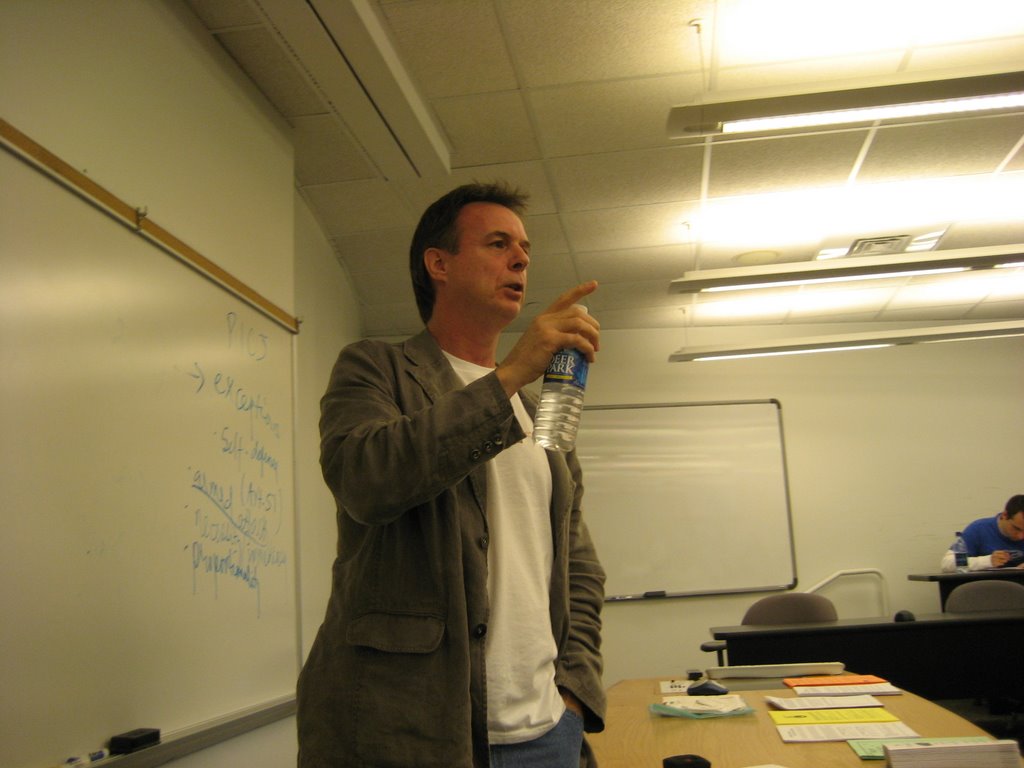
Above: Journey of Hope participant Robert Hoelscher, who has been bringing us regular updates on the progress of the Journey of Hope...From Violence to Healing, talks to law students at the College of William and Mary.
The latest dispatch (actually, three dispatches) from Robert:
On Tuesday, October 24, Tracy Spirko and I visited two criminology classes at University of Mary Washington taught by Dr. Joan Olson (thank you Joan!). About two of every three students signed the petitions asking for a death penalty moratorium in Virginia. The students (even those at the 8 a.m. class) were very attentive and respectful and asked lots of questions. These classes don't offer a huge block of time to talk. And it would be unreasonable to expect anyone to fully comprehend all sides of a topic they may not have given much thought to. So the best measure I can think of regarding our discussion is simply to ask the class if our information was helpful. Most nod their heads and say it was. To me, that's a successful event. Our host Debbie Simpson arranged dinner for me and Tracy with some very nice members of her church. Again, we are so grateful for the hospitality extended to us.
On Monday, October 23, Tracy Spirko (family member of death row prisoner) and I visited a group of law school students at the William & Mary Law School in Williamsburg. This was a real treat for me because these law students were also forming an innocence project to investigate suspected cases of wrongful conviction. I had worked for five years for innocence projects in Louisiana and Texas. And Tracy's husband John has been claiming his innocence for every day of his 24 years on Ohio's death row. On top of that, to my pleasant surprise, Virginia exoneree Beverly Monroe attended. I met Beverly two years ago at the National Innocence Network Conference in Austin, Texas where she participated in a panel discussion that I organized. Bottom line, a grand time was had by all. After this event, Tracy and I continued on to Fredericksburg, where we would be speaking on Tuesday and Wednesday. We were greeted in Fredericksburg by local activist Debbie Simpson, who served as our host for the next two days. I cannot say enough about the kindness and generosity of Journey activists and volunteers who, like Debbie, have been so important in making this adventure possible.
Sunday, October 22 was another caravan day. We checked out of Richmond and headed to Williamsburg and a noon event with Sister Helen at the William and Mary Catholic Campus Ministry. It was a great crowd (over 150). Sister Helen was introduced by William and Mary President Gene R. Nichol. She gave another rousing performance. Then on we went to Norfolk and our last event with Sister Helen at the Church of the Ascension in Virginia Beach. This was our largest audience (over 400) on the Journey. After this event, we gathered in our hospitality room at the hotel for some personal time with Sister Helen. She regaled us with a few "Boudreaux" jokes from Louisiana. It was a hoot. Time flies when you're having fun. Most of us didn't hit the sack until the wee hours of the morning.

Tuesday, October 24, 2006

Above: Activist Abe Bonowitz gets a much-needed massage from Journey of Hope participant SueZann Bosler (with an assist from little Isaac Bonowitz!)
Here's the latest posting from Robert Hoelscher as the Journey prepares for its final week:
Saturday, Oct. 21 was rest day. Clothes got washed. And several of us received hairdressing services from family member SueZann Bosler. Mine included an all purpose touch up which left me confident that I was free of unsightly nose hair.
Tonight we gathered at St. Edward's Catholic Church in Richmond for our first major event with Sister Helen Prejean. Before Sister Helen spoke, each JOH participant placed a rose dedicated to a loved one in a vase. This ritual was very powerful and emotional for both the audience and the JOH folks. Tears were in abundance.
Sister Helen was her usual sassy self. The thing about Sister Helen is that she is as
authentic as it gets. Her passion to abolish the death penalty comes from the
depths of her faith and her up close and personal relationships with those affected by the capital punishment. When we were driving back to the hotel, activist Claire (sorry Claire, forgot your last name) recalled the first time she met Sister Helen. "I fell in love with her in about eight seconds." That, indeed, is Sister Helen.
The Ridge Baptist Church is right down the street from our hotel. The sermon tomorrow is "Finding Strength in Broken Places." That is what the Journey of Hope is all about. And from this strength we will defeat the broken death
penalty.
Monday, October 23, 2006
Halfway home!

Above: Some of the journey crew pose for a group shot after dinner at the Super King buffet.
The Journey of Hope...From Violence to Healing continues. Here's the latest report from Robert Hoelscher, Journey participant and campaign coordinator for Murder Victims' Families for Reconciliation:
Friday, Oct. 20 was the halfway point of the Journey. We have been to Northern Virginia, Charlottesville, Harrisonburg, Lexington, Roanoke, and now Richmond. At this point we have spoken at over 50 events, to hundreds and hundreds of people, about how the death penalty fails America and doesn't serve victims.
During my morning jog, I ran through a nearby neighborhood. It was a modest, older middle-class enclave of homogeneous brick homes hugged by a forest of towering trees. There were no storm sewers, no curbs, no garages or paved driveways. Flags (Old Glory, Washington Redskins, Virginia Tech) and Halloween pumpkins animated porch fronts. A fellow drove by and waved to me, probably thinking I was a local. I found myself thinking that the fate of the death penalty will be decided in neighborhoods like this one. Maybe we'll see one of these residents this weekend.
At noon a number of us went into downtown Richmond for a Burma Shave/Visibility event. For about an hour, we stood on the sidewalk inviting honks of support from
passing drivers. The honks came steadily. Our informal survey concluded that
most of the responses came from people of color and young people. No real surprise. But maybe our other supporters were just too shy to honk.Many new family members and others have joined the Journey this weekend. And of course our special friend Sister Helen Prejean will be with us tomorrow for a major event at St. Edwards Catholic Church here in Richmond.
A big pack of us caravaned to dinner at the Super King Buffet. The best damn buffet I've ever been to. We pigged out on an assortment of delightful dishes that included seafood, sushi, and Asian offerings. I did take a pass on the chicken legs, however.
After a week as part of the Journey, I am comforted by the warmth and spirit of this
unique tribe of individuals. This is like an instant family. You meet someone for the first time and you know you are connected in a special way. It's spontaneous friendship. And the joy that these folks express, the affection they have for laughter in spite of the wounds they carry with them, is truly a wonder to behold. If we could bottle what these people have, we really could have peace on earth. And end the death penalty while we're at it.
Friday, October 20, 2006
Kicking it up a notch
 Above: Isaac Bonowitz -- Never too young for the Journey of Hope!
Today's Journey of Hope...From Violence to Healing blogging continues with Robert Hoelscher's latest report from the road:
Thursday began with most folks moving from Roanoke to Richmond (state capital). Once again, I was privileged to ride with our JOH mascot Isaac Bonowitz and activist mother Beth. Once in Richmond, family member Bud Welch and I headed over to Randolph-Macon College to speak. It was a small but attentive group. Bud's tender story about his daughter Julie, who was killed in the Oklahoma City bombing attack, just gets better with age. His relationship with the father of Timothy McVeigh is a wonderful testimony to the power of forgiveness.
The rest of the JOH brood attended events in Charlottesville, Lynchburg, Roanoke, and Lexington, spreading words of love and reconciliation.
Inside sources tell me that JOH storytellers/family members SueZann Bosler and Christina Lawson are getting JOH tattoos tonight. I have confirmed that each will be
in a region permitting photographs, for which I have exclusive rights.
I must also report that Virginia is an absolutely beautiful state. Just about every road we've been on has offered breathtaking scenery. The trees are thick across the countryside and ablaze in their fall glory.
Tomorrow begins our weekend with Sister Helen Prejean. The JOH is about to "kick it up a notch."
Thursday, October 19, 2006
The Journey continues

Above: Robert poses with the high school youth group at Salem Presbyterian Church
Here's the daily Journey of Hope...From Violence to Healing installment from Robert Hoelscher, Journey participant and campaign coordinator for Murder Victims' Families for Reconciliation:
On Wednesday we packed up in Harrisonburg and set out for Roanoke. I caravaned in the abolitionmobile with JOH co-founder George White, family member Aba Gayle, activist Beth Wood-Bonowitz and her JOH mascot son Isaac (son of Abe
Bonowitz), family member Christina Lawson, and activist Steve "I Sell Music on E-Bay" Louis. We had lunch on the road at the Whistle Stop Cafe. Yes, I had fried green tomatoes. They was yummy.
After we got set up in Roanoke, local VDAP activist Gene Edmunds (thank you Gene!) escorted me to the Salem Presbyterian Church where I visited with a high school youth group. We talked for about an hour in a "living room" setting. I told the story of losing my father at age 7. And how my mother had called the offender's parents just two days after the murder to offer forgiveness. At the end, I asked if our discussion had helped. They all seemed to think it had. One student mentioned
that the most she had really thought about the death penalty was through the
humor of comedian Ron "Tater Salad" White who has a joke about Texas using the
"express lane" for its death penalty. I tried to encourage them always to look
deeply at issues where fellow human beings are involved. I believe they will.
We're having a "debriefing" of the days events in a few minutes. I'm off to check it out.
Wednesday, October 18, 2006
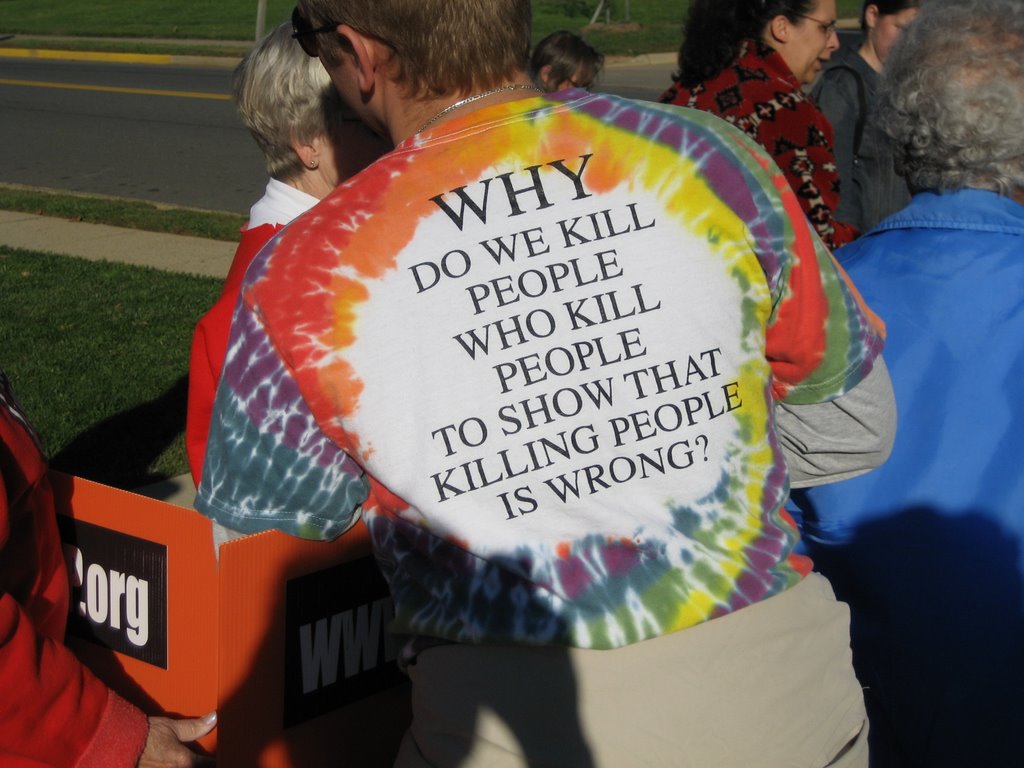
Cool T-shirt, huh?
Here's the latest installation from Robert Hoelscher, campaign coordinator for Murder Victims' Families for Reconciliation and a participant in the ongoing Journey of Hope...From Violence to Healing:
Yesterday (Monday, October 16) teams fanned out into Northern Virginia for events at a high school, prison, university, a Catholic church, and on Capital Hill in Washington, DC. I pulled out about 3 p.m. with family member Vera Crutcher and death row family member Tracy Spirko to head to Charlottesville for the night, where we stayed at the home of Democratic activists and JOH supporters Tom and Betty Gallagher (thank you Tom and Betty!). As the evening wound down, I talked for awhile with Tracy, who was on the computer cruising the internet trying to find out whether Gov. Taft of Ohio had issued a reprieve for her husband John, who has an execution date. She went to bed with no answer.
This morning (Tuesday, October 17) Vera, Tracy, Betty and I met with Virginia state delegate David Toscano. David is a staunch abolitionist and spent a gracious hour with us discussing legislative strategies to advance death penalty related issues. It was a good meeting. While we were meeting with David in Charlottesville, the rest of the group "broke camp" in Falls Church and headed to Harrisonburg for the next
phase of the Journey. We drove over to Harrisonburg after our meeting.
This afternoon in our hotel we were treated to massage services donated by a local JOH supporter. One after the other, Journey participants filed into Room 151 for a genuine "ahhhhh" refresher. Boy, did it hit the spot. As I write this, the crew is out doing evening events at James Madison University here inHarrisonburg, the Central United Methodist Church in Staunton, and the Augusta Coalition for Peace and Justice in Waynesboro.
Tomorrow (Wednesday, October 18) looks like a very full day, at the end of which we'll go to Roanoke. I still await my "inaugural" JOH storytelling event, what with group events on Saturday, the cancelled event on Sunday due to bad directions, travel yesterday, and a one-on-one meeting today. I'm looking forward to finally sharing the experience the others are having. Stories are starting to trickle back of tears shed, changing hearts and minds, and other special moments.
Tuesday, October 17, 2006
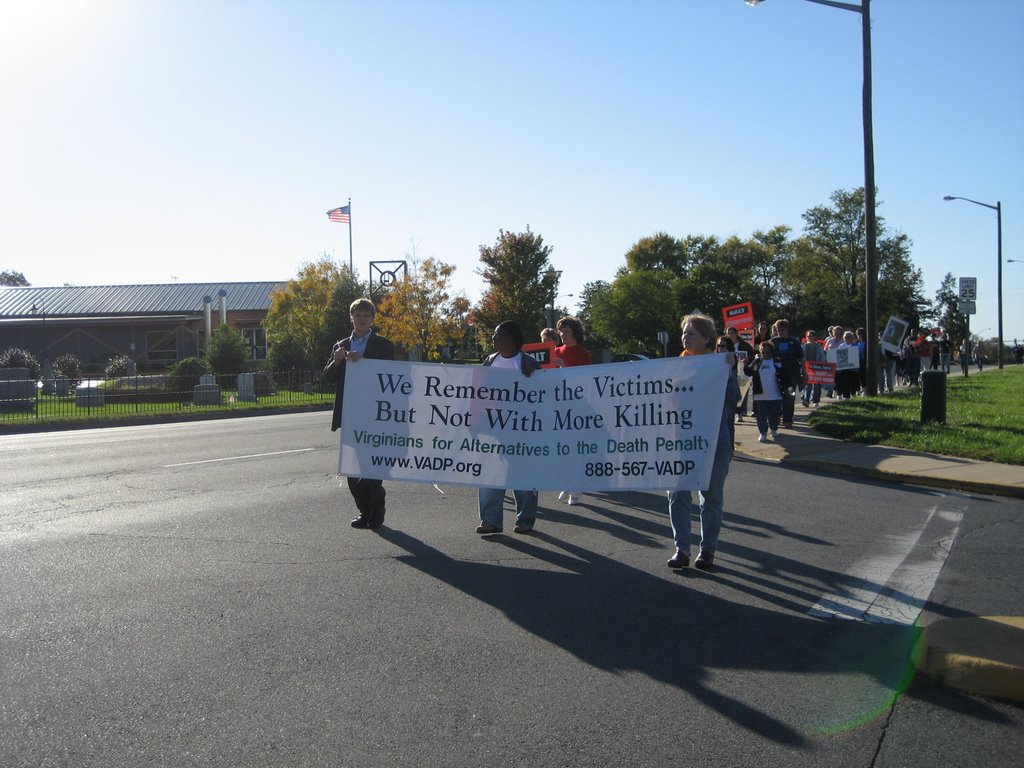 Above: Journey of Hope participants kick it off with a march and rally!
Here's the latest update from Robert Hoelscher:
This afternoon, we drove an hour to Manassas in Prince William County, the jurisdiction that produces the most death sentences in Virginia. On the way, we passed a service station with regular at $1.91 a gallon. We observed a moment of silence in celebration of sub-two dollar gas. In Manassas, our group of about 75 marched from the All Saints Catholic Church to the Manassas Peace Pole, where VADP executive director Jack Payton-Travers thrashed the death penalty in Virginia, urging the state to enact a moratorium on capital punishment. Following Jack, Pennsylvania death row exoneree and now Manassas resident Harold Wilson and murder victim family member SueZann Bosler shared their stories and joined in the call for a moratorium. It wasn't the Million Man March, but it was nonetheless a fine start for the Journey of Hope. The good people of All Saints Catholic Church hosted an after-march meal (my third straight with a pasta entree, but hey, I'm not
complaining).
Monday, October 16, 2006
Day One: Journey of Hope

Pictured above: During an orientation for Journey of Hope participants, Jack Payden-Travers and Connie Watts point to the route the entourage will travel as they make their way across the state.
This is the second in what will be a series of posts from Robert Hoelscher, campaign coordinator for Murder Victims' Families for Reconciliation and a participant in the Journey of Hope...From Violence to Healing.
Last night I dreamt that I kept going into the wrong rooms - naked - at the hotel where we are staying these first four nights. Five bucks to any shrink (amateur or otherwise) that can translate that piece of "too much information."
This morning while out on a run I was looking for a store to grab some orange juice and a snack bar. No surprise, I find a neighborhood 7/11. There's a million of them of course. But there were only a few dozen in 1961 when my father, the manager of a suburban Houston 7/11, was murdered during a robbery. I've gone into 7/11's a million times since then and rarely associate the visits with my father. But today it felt different. Today I was remembering.
This morning we had our orientation and training session. We started out by being led in song, "break 'em on down these walls between us, break 'em on down."Then everyone introduced themselves and I saw a glimpse of the power and poignancy of these stories. We not only have murder victim family members, but also family members of death row inmates, and former prisoners who were exonerated from death row. Along with the dedicated activists who are the logistical backbone of this great project. I can sense the magic about to be unleashed.
We leave in about an hour for the kick-off march and rally. I have my Journey of Hope t-shirt and I'm good to go.
Friday, October 13, 2006
Journey of Hope 2006 launches!
.jpg)
The picture above is a bit dark -- it shows Connie Watts, organizer for the Journey of Hope...From Violence to Healing. But if you look closely at the table in front of Connie, you can see that Journey participants have their media kits, notebooks, pens, clipboards and other materials they need to take Virginia by storm.
Because tomorrow is Day One of a two-week journey that will culminate with the annual conference of the National Coalition to Abolish the Death Penalty.
From the front lines, Robert Hoelscher, a Journey participant and campaign coordinator for Murder Victims' Families for Reconciliation, reports:
Today, I'm on my way to the Virginia Journey of Hope 2006. Every day for the next two weeks, starting tomorrow, murder victim family members opposed to the death penalty will tell our stories at over 100 events across the state. My flight from Austin to Virginia went through Chicago. It was a picture perfect day, bright sun and few clouds. As the plane turned to land at Midway Airport, something caught my eye on the ground below. It was a cemetery. The sun was bouncing off the marble headstones, creating a festival of flickering light. I think of these next two weeks. And how our stories will chronicle a graveyard of death. The thought sits heavy in my chest.
Keep an eye on this space. We'll be blogging the Journey "live," just as often as Robert (and possibly others) can access a computer and send in the stories of their journey.
Wednesday, October 04, 2006
Tuesday's Focus: Vicki Schieber
We apologize for being a day late with the latest installment in our Tuesday's Focus series. Today we look at the journey of Vicki Schieber:
Vicki Schieber’s daughter, Shannon, was raped and murdered on May 7, 1998 while finishing her first year of graduate school on a full scholarship at the Wharton School at the University of Pennsylvania.
Shannon’s killer was not arrested until 2002. He is serving several life sentences without parole in Colorado and Pennsylvania not only for Shannon’s rape and murder but for 13 other sexual assaults as well.
Vicki and her husband, Sylvester, both Maryland residents, testified in support of a Maryland bill that would extend that state’s moratorium on executions and create a commission to study the way the death penalty is imposed. She also testified in Pennsylvania for the abolition of the death penalty alongside former Illinois governor George Ryan and exonerated former death row inmates, including Kirk Bloodsworth.
She has taught many high school and university classes on abolition, run workshops at state conferences, and published op-ed pieces in newspapers including the Philadelphia Inquirer and the Washington Post. She also has met with and testified before state legislators in Maryland, Pennsylvania and Virginia.
Vicki was vocal in her opposition to the death penalty long before Shannon’s murderer was apprehended. The Schiebers fought the district attorney and the prosecutors to keep the death penalty from being applied to their daughter’s killer.
“The death penalty is against our religion, a belief system in which life is held to be sacred,” she says. “We know that there are many inequities in how the states apply the death penalty. Therefore I believe MVFHR must focus on abolition in the context of its being a human rights issue and work hard to bring the world community of murder victims together to oppose the death penalty in the U.S. I have traveled in many parts of the world and citizens in other countries are appalled at the inequitable application of this sentence in our homeland.”
Vicki, who has spent her career in a variety of financial marketing and management roles, was profiled on “Dateline NBC”, a show which also aired multiple times on Court TV. Her story is part of an NBC film on the death penalty sponsored by the Robert Kennedy Foundation.
She has long been active in leadership positions in non-profits dedicated to literacy and programs for elderly, disabled and low-income residents of Washington, D.C.
Vicki is the recipient of the Fannie Mae Foundation Good Neighbor Award, the Courage in Community Award of the McAuley Institute Board of Trustees and the Exceptional Community Spirit Award from Rebuilding Together of Washington, D.C.
Links to Vicki's journey:
Vickie’s Story: Go to MVFHR Board of Directors for more of Vicki’s story
May Brings Relief for Vicki Schieber: Having suspect in Shannon's killing eases pain this Mother's Day
…Vicki Schieber said: "I have forgiven him
"It would be an insult to our daughter's memory to put another person to death," Vicki Schieber said, "even the murderer of our daughter."
What happened when one state governor declared a moratorium on capital punishment?
Testimony of MVFHR's Vicki Schieber to the U.S. Senate
Vicki Schieber’s daughter, Shannon, was raped and murdered on May 7, 1998 while finishing her first year of graduate school on a full scholarship at the Wharton School at the University of Pennsylvania.
Shannon’s killer was not arrested until 2002. He is serving several life sentences without parole in Colorado and Pennsylvania not only for Shannon’s rape and murder but for 13 other sexual assaults as well.
Vicki and her husband, Sylvester, both Maryland residents, testified in support of a Maryland bill that would extend that state’s moratorium on executions and create a commission to study the way the death penalty is imposed. She also testified in Pennsylvania for the abolition of the death penalty alongside former Illinois governor George Ryan and exonerated former death row inmates, including Kirk Bloodsworth.
She has taught many high school and university classes on abolition, run workshops at state conferences, and published op-ed pieces in newspapers including the Philadelphia Inquirer and the Washington Post. She also has met with and testified before state legislators in Maryland, Pennsylvania and Virginia.
Vicki was vocal in her opposition to the death penalty long before Shannon’s murderer was apprehended. The Schiebers fought the district attorney and the prosecutors to keep the death penalty from being applied to their daughter’s killer.
“The death penalty is against our religion, a belief system in which life is held to be sacred,” she says. “We know that there are many inequities in how the states apply the death penalty. Therefore I believe MVFHR must focus on abolition in the context of its being a human rights issue and work hard to bring the world community of murder victims together to oppose the death penalty in the U.S. I have traveled in many parts of the world and citizens in other countries are appalled at the inequitable application of this sentence in our homeland.”
Vicki, who has spent her career in a variety of financial marketing and management roles, was profiled on “Dateline NBC”, a show which also aired multiple times on Court TV. Her story is part of an NBC film on the death penalty sponsored by the Robert Kennedy Foundation.
She has long been active in leadership positions in non-profits dedicated to literacy and programs for elderly, disabled and low-income residents of Washington, D.C.
Vicki is the recipient of the Fannie Mae Foundation Good Neighbor Award, the Courage in Community Award of the McAuley Institute Board of Trustees and the Exceptional Community Spirit Award from Rebuilding Together of Washington, D.C.
Links to Vicki's journey:
Vickie’s Story: Go to MVFHR Board of Directors for more of Vicki’s story
May Brings Relief for Vicki Schieber: Having suspect in Shannon's killing eases pain this Mother's Day
…Vicki Schieber said: "I have forgiven him
"It would be an insult to our daughter's memory to put another person to death," Vicki Schieber said, "even the murderer of our daughter."
What happened when one state governor declared a moratorium on capital punishment?
Testimony of MVFHR's Vicki Schieber to the U.S. Senate
Tuesday, September 26, 2006
Tuesday's Focus: Ruth Andrews
The latest installment of our continuing Tuesday's Focus series examines the journey of Ruth Andrews:
Ruth Andrews is an ethnic Mennonite. She has always believed the death penalty is immoral.
Ruth’s mother's murder (when she was 16) didn't change that, although it changed everything else. Since the crime was never solved, Ruth couldn't take her anger out on anyone. Instead, she took it out on herself. For the next ten years she lived recklessly and was dangerously self-destructive. It wasn't until Ruth became pregnant that she began to care for herself again.
Another turning point in her healing occurred at a conference on forgiveness, when Ruth asked a murderer to pray for her. On the Journey of Hope in Georgia in 1994, Ruth was paired with a woman who had a son on death row, “The similarities in our experiences were remarkable. I felt closer to her than to the "good" people I'd known all my life. I'm very grateful to belong to the Journey of Hope.“
Links to Ruth’s Journey:
Slaying victim's daughter fights death penalty
Cassopolis woman in Houston in effort to abolish death penalty
Peacemaking, Terrorism and Art: By Ruth Andrews
Ruth Andrews is an ethnic Mennonite. She has always believed the death penalty is immoral.
Ruth’s mother's murder (when she was 16) didn't change that, although it changed everything else. Since the crime was never solved, Ruth couldn't take her anger out on anyone. Instead, she took it out on herself. For the next ten years she lived recklessly and was dangerously self-destructive. It wasn't until Ruth became pregnant that she began to care for herself again.
Another turning point in her healing occurred at a conference on forgiveness, when Ruth asked a murderer to pray for her. On the Journey of Hope in Georgia in 1994, Ruth was paired with a woman who had a son on death row, “The similarities in our experiences were remarkable. I felt closer to her than to the "good" people I'd known all my life. I'm very grateful to belong to the Journey of Hope.“
Links to Ruth’s Journey:
Slaying victim's daughter fights death penalty
Cassopolis woman in Houston in effort to abolish death penalty
Peacemaking, Terrorism and Art: By Ruth Andrews
Tuesday, September 19, 2006
Tuesday's Focus: Rev. Walt Everett
Today, as the latest in our Tuesday's Focus installment we bring you the story of Rev. Walt Everett of Connecticut:
In 1987 Walt Everett’s son, Scott, was shot and killed at the age of 24. For almost a year afterwards, Walt’s emotional state moved from rage to depression. He found it difficult to even go through the motions of his work as pastor of a United Methodist Church.
It was only at the sentencing when he heard Mike Carlucci express remorse for killing Scott that Walt felt God nudging him towards forgiveness. Walt describes this journey as the most difficult thing he has ever had to do.
He wrote to Mike on the first anniversary of Scott’s death. Thus began a correspondence, which led to visits and finally to Walt’s testifying on Mike’s behalf at a parole hearing. Based on this testimony, Mike obtained an early release and went to work for a trucking firm where his boss described him as “the best supervisor I ever had.”
Walt and Mike often speak together at universities, churches and community groups about the healing power of forgiveness, healing for both the forgiven and forgiver.
Walt is a pastor of United Methodist Church of Hartford, Connecticut. He met his wife at a bereavement group and between them they have six children, four of whom are still living, and eight grandchildren.
Walt is an ardent advocate of the anti-death penalty movement and is active in numerous abolition and restorative justice organizations. His story has been told in numerous publications including an extensive profile in Rolling Stone.
Links to Walt’s Journey:
Father Forgives the Man Who Murdered His Son
The Transformative Power of Forgiveness
The Mercy Minute: Unconditional Love
Yesterday, I drove Walt Everett and his wife Nancy to an event at a Catholic church in McKinney, Texas.
Sermon: One Hand Clapping
State Counts Down to Killers Death
Speakers on Capital Punishment audio file
In 1987 Walt Everett’s son, Scott, was shot and killed at the age of 24. For almost a year afterwards, Walt’s emotional state moved from rage to depression. He found it difficult to even go through the motions of his work as pastor of a United Methodist Church.
It was only at the sentencing when he heard Mike Carlucci express remorse for killing Scott that Walt felt God nudging him towards forgiveness. Walt describes this journey as the most difficult thing he has ever had to do.
He wrote to Mike on the first anniversary of Scott’s death. Thus began a correspondence, which led to visits and finally to Walt’s testifying on Mike’s behalf at a parole hearing. Based on this testimony, Mike obtained an early release and went to work for a trucking firm where his boss described him as “the best supervisor I ever had.”
Walt and Mike often speak together at universities, churches and community groups about the healing power of forgiveness, healing for both the forgiven and forgiver.
Walt is a pastor of United Methodist Church of Hartford, Connecticut. He met his wife at a bereavement group and between them they have six children, four of whom are still living, and eight grandchildren.
Walt is an ardent advocate of the anti-death penalty movement and is active in numerous abolition and restorative justice organizations. His story has been told in numerous publications including an extensive profile in Rolling Stone.
Links to Walt’s Journey:
Father Forgives the Man Who Murdered His Son
The Transformative Power of Forgiveness
The Mercy Minute: Unconditional Love
Yesterday, I drove Walt Everett and his wife Nancy to an event at a Catholic church in McKinney, Texas.
Sermon: One Hand Clapping
State Counts Down to Killers Death
Speakers on Capital Punishment audio file
Tuesday, September 12, 2006
Tuesday's Focus: Shujaa Graham
Our Tuesday's Focus series continues today with a look at California death row exonoree Shujaa Graham:
Shujaa Graham was born in Lake Providence, LA, where he grew up on a plantation. His family worked as share-croppers, in the segregated South of the 50s. In 1961, he moved to join his family who had moved to South Central Los Angeles, to try to build a more stable life. As a teenager, Shujaa lived through the Watts riot and experienced the police occupation of his community. In and out of trouble, he spent much of his adolescent life in juvenile institutions, until at age 18, he was sent to Soledad Prison.
Within the prison walls, Shujaa came of age, mentored by the leadership of the Black Prison movement. Shujaa taught himself to read and write, he studied history and world affairs, and became a leader of the growing movement within the California prison system, as the Black Panther Party expanded in the community.
In 1973, Shujaa was framed in the murder of a prison guard at the Deul Vocational Institute, Stockton, California. As a recognized leader within and without the prison, the community became involved in his defense, and supported him through 4 trials. Shujaa and his co-defendant, Eugene Allen, were sent to San Quentin's death row in 1976, after a second trial in San Francisco. The DA systematically excluded all African American jurors, and in 1979, the California Supreme Court overturned the death conviction.
After spending three years on death row, Shujaa and Eugene Allen, continued to fight for their innocence. A third trial ended in a hung jury, and after a fourth trial, they were found innocent. As Shujaa often says, he won his freedom and affirmed his innocence in spite of the system.
Shujaa was released in March, 1981, and continued to organize in the Bay area, building community support for the prison movement, as well as protest in the neighborhoods against police brutality.
In the following years, Shujaa moved away from the Bay area. Shujaa learned landscaping, and created his own business. He and his wife raised three children, and became part of a progressive community in Maryland.
In 1999, Shujaa was invited to speak about his experiences on Death Row at fund raiser for the Alabama Death Penalty project, sponsored by the New York Legal Aid Foundation. This was a new beginning, and provided Shujaa the opportunity to begin to tell his story, his experiences and grow through work with other death penalty opponents.
Links to Shujaa’s Journey:
Shujaa’s web site
Campaign to End The Death Penalty
Faces of Wrongful Conviction
Death penalty debated The Post and Courier
The New Abolitionist: I See This Struggle As A New Challenge
Former Inmate Condemns Capital Punishment
A Life’s Sentence
STOP The Death Penalty
Shujaa Graham Quotes:
"I was framed because of my beliefs and because I was outspoken about prison conditions."
"We need a government that would be so sensitive to the needs of the people that its every endeavor would be towards building peace and happiness and not preying on the misery of people. And that’s really how the death penalty goes--it preys upon people’s fears"
"I've tried to integrate the prison issue with other movements. My politics go far beyond prison itself, but because I’ve been in prison, I felt a responsibility to try to expose the conditions of prison life, to fight against new prisons, to address how the disenfranchised will be tomorrow’s victims of the prison system.
“I stand here wounded by the blows of the death penalty of racism, trying to end this awful reality”
Shujaa Graham was born in Lake Providence, LA, where he grew up on a plantation. His family worked as share-croppers, in the segregated South of the 50s. In 1961, he moved to join his family who had moved to South Central Los Angeles, to try to build a more stable life. As a teenager, Shujaa lived through the Watts riot and experienced the police occupation of his community. In and out of trouble, he spent much of his adolescent life in juvenile institutions, until at age 18, he was sent to Soledad Prison.
Within the prison walls, Shujaa came of age, mentored by the leadership of the Black Prison movement. Shujaa taught himself to read and write, he studied history and world affairs, and became a leader of the growing movement within the California prison system, as the Black Panther Party expanded in the community.
In 1973, Shujaa was framed in the murder of a prison guard at the Deul Vocational Institute, Stockton, California. As a recognized leader within and without the prison, the community became involved in his defense, and supported him through 4 trials. Shujaa and his co-defendant, Eugene Allen, were sent to San Quentin's death row in 1976, after a second trial in San Francisco. The DA systematically excluded all African American jurors, and in 1979, the California Supreme Court overturned the death conviction.
After spending three years on death row, Shujaa and Eugene Allen, continued to fight for their innocence. A third trial ended in a hung jury, and after a fourth trial, they were found innocent. As Shujaa often says, he won his freedom and affirmed his innocence in spite of the system.
Shujaa was released in March, 1981, and continued to organize in the Bay area, building community support for the prison movement, as well as protest in the neighborhoods against police brutality.
In the following years, Shujaa moved away from the Bay area. Shujaa learned landscaping, and created his own business. He and his wife raised three children, and became part of a progressive community in Maryland.
In 1999, Shujaa was invited to speak about his experiences on Death Row at fund raiser for the Alabama Death Penalty project, sponsored by the New York Legal Aid Foundation. This was a new beginning, and provided Shujaa the opportunity to begin to tell his story, his experiences and grow through work with other death penalty opponents.
Links to Shujaa’s Journey:
Shujaa’s web site
Campaign to End The Death Penalty
Faces of Wrongful Conviction
Death penalty debated The Post and Courier
The New Abolitionist: I See This Struggle As A New Challenge
Former Inmate Condemns Capital Punishment
A Life’s Sentence
STOP The Death Penalty
Shujaa Graham Quotes:
"I was framed because of my beliefs and because I was outspoken about prison conditions."
"We need a government that would be so sensitive to the needs of the people that its every endeavor would be towards building peace and happiness and not preying on the misery of people. And that’s really how the death penalty goes--it preys upon people’s fears"
"I've tried to integrate the prison issue with other movements. My politics go far beyond prison itself, but because I’ve been in prison, I felt a responsibility to try to expose the conditions of prison life, to fight against new prisons, to address how the disenfranchised will be tomorrow’s victims of the prison system.
“I stand here wounded by the blows of the death penalty of racism, trying to end this awful reality”
Tuesday, September 05, 2006
Tuesday's Focus: Abe Bonowitz
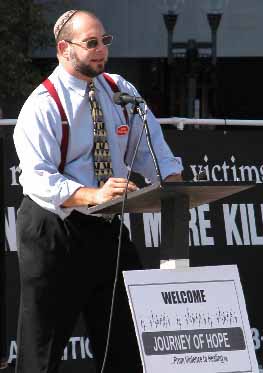 (blogger's note: the above photo was taken by Scott Langley. You can see more of Scott's outstanding work here.)
The latest installment of the Tuesday's Focus series takes a look at anti-death penalty activist Abe Bonowitz. In his own words, Abe explains how participation in the Journey of Hope...From Violence to Healing affected him. Remember, the Journey will visit Virginia this October. You can learn more and find out how to get involved by going here.
Here is Abe's message:
Dear Friends,
As many of you know, I have not always opposed the death penalty. When I tell the story of my transition, I say, "The facts changed my mind, and the people I met on the Journey changed my heart."
By 1993, I had become a fairly active anti-death penalty activist through my involvement with Amnesty International, but I would still say things like, "IF we could make it fair and equal, I would pull the switch myself." But when I went on the Indiana Journey of Hope ...From Violence to Healing, I met and learned first hand the stories of people who have been "in the fire," as Sister Helen would say. It was certainly inspiring to meet and work with people like Bill Pelke, Marietta Jaeger, Marie Deans and SueZann Bosler and so many others who have lost loved ones to murder and forgiven the perpetrator. But what touched my heart -- what *changed* my heart -- was learning the stories of people like George White (with the double whammy of seeing his wife murdered and then being wrongly convicted of the killing) and Sunny Jacobs (with the double whammy of being wrongly convicted *with* her husband, who was also wrongly executed!), and others, including Randall Dale Adams, who was wrongly convicted and was nearly Texecuted. What changed my heart even more, was meeting people like Shirley Dicks, Ken & Lois Robison, Jill Fratta, Catherine Forbes, and so many others who have had a loved one convicted of murder - rightly or wrongly - and who themselves have been put through the wringer by a society that condemns killing but ignores the collateral damage created in the process of exacting revenge through execution.
Being on the Journey allowed me to not only meet these people and hear their stories. I got to know them. And by hearing their stories several times in front of different audiences as we spent 17 days traversing a state, I got to *know* their stories. Ever since that 1993 Journey, whenever someone attempts to dismiss me by saying I'd "feel different if my loved one was murdered," I respond with, "Maybe you are right, but let me tell you about my friend Bill (or Sunny or Sam or Marietta). And I share the stories I learned on the Journey. And it works!
ALSO on the Journey, I got plenty of practice talking about the death penalty as an activist. I learned how to lead marches, how to better convey our message through the media, how to handle hate-filled opposition with a loving response, and how important it is to provide a hug for a person who has just relived the most painful experience in their life over and over again.
The Journey made me the activist I am today. There is no better training ground for abolitionists. Period.
paz!
Links to Abe’s Journey:
Biography of Abe Bonowitz
Death Penalty Opponents Gather
Protesters Converge on Prison
Journey of Hope in Monterey
Journey Of Hope ...From Violence to Healing, Inc.
Seven Arrested on 25th Gilmore Anniversary
Opponents of the death penalty speak out
Marchers Spotlight Growing Scrutiny of Florida Death Penalty
A Discussion with Jeb Bush on the Death Penalty
Execution May Only Spur More Killing: Reflections on the "Martyrdom" of Paul Hill
Subscribe to:
Posts (Atom)